Category Archives: Uncategorized

Rule #1 of Video Storytelling – Edit in Your Head FIRST!

FIRST RULE of video storytelling: edit in your head before you hit record. If you shoot too much footage a) you’ll struggle to edit it; b) you’ll lose track of the story; and c) the result will be hard to watch. Chances are you’ll lose heart and never finish your first story.

So here’s how to edit in your head. Don’t even touch your camera/smartphone until you’ve asked your potential interviewee these questions:

  1. “Hello, what’s going on here?” Start by asking about action and practical stuff, not opinions, theories, motivations or anything else. Keep it simple. This will settle your interviewee down: you’re talking to them about something they understand. Follow up with “Can you show me?” Again, this reassures your interviewee and puts them in control of the conversation. Plus it tells you what’ll make good pictures. As far as your audience is concerned, seeing is believing.
  2. “What’s surprising about this job? Tell what’s particularly good (or bad) about it?” These questions will start to uncover what’s exceptional or unusual: this is the stuff which grabs your audience’s attention. Listen very carefully for emotion (frustration, satisfaction, pride etc). Play these emotions back to your interviewee in the form of questions:
  3. “So, is it very rewarding? … frustrating? etc” If you’ve been listening carefully, you’ll call this right and your interviewee will really open up. You can follow up by asking “Why do you feel… ?” Don’t be tempted to dodge emotion because if feels a bit uncomfortable or nosey. Every story needs an emotional element.
  4. Bonus questions: “Why does this matter?”  or “What should other people think or do about this?” might throw something really interesting up. Always worth asking “Have I missed anything important?”

Ok, so that’s your basic research. Now you’re ready to edit in your head.

First Edit: Just Three Questions.  Ask yourself “what are the three questions I can answer in this story?” There’s no point trying to answer more, it just gets confusing. Here’s an example of three basic questions any story can answer:

  • What’s going on? Can you show me?
  • How do you feel about this?
  • Why does this matter?

Second Edit: Show and Tell.  Figure out what you can film or photograph that shows what the interviewee is telling you. Remember: seeing is believing.

Third Edit: Practical and Safe. You’ve got to film with decent light and audio, otherwise you’re wasting your time. Don’t interview anyone where there’s lots of background noise. Your ears filter it out, but your camera won’t. And don’t put yourself into any kind of dangerous situation to try and get a good shot.

Here’s a tip for filming with strong light:

FINALLY you’re ready to pick up the camera. Remember to shoot in short bursts. This will make the final edit on a computer much easier.

3 Reasons Why 3 is the Magic Number for Your Story

We love threes in stories. Other numbers are also available: 12 Apostles, 10 Commandments, Seven Deadly Sins, the Famous Five and Fantastic Four. But we find threes again and again (and again): Perseus and Macbeth meet three witches; Goldilocks deals with three bears; Wise Monkeys, Wishes and Little Pigs all come in threes. We even structure stories themselves in threes: past, present and future; before, during and after; beginning, middle and end.

Winston Churchill loved a tricolon (the rhetorical use of threes). He famously promised the British people “blood, sweat and tears” in the dark hours of World War Two. Actually, he promised “blood, sweat, toil, and tears”, but we only remember three out of the four.

So, here are three reasons why we love threes, followed by some ways (guess how many) that you can use threes in your next story or presentation.

  1. Three is short. You can get three things into a tweet or onto a slide.
  2. Three is enough. We can hold between five and seven things in our minds at once. When you allow for distractions (“Ooh, I wonder if I’ve had any likes yet”, “That guy’s looking at me funny”, “How long’s this going to take?”) there’s only room in your listeners’ heads for three things you want to say, max.
  3. Three is a pattern. Once is just a random event. Twice might be coincidence. Three times is proof (in a folksy, rule-of-thumb sort of way). Four is just more of the same. Five, a boring list.

So how can you use threes when you’re telling a story or making a presentation?

  1. Emphatic Three. Tony Blair’s “Education, education, education” or Margaret Thatcher’s “No, no, no!” Simple repetition or on a rising scale: OK, we get it.
  2. Set Up and Contrast Three. “Never before in the field of human conflict has so much been owed by so many to so few.” Churchill’s Battle of Britain tribute sets up the huge scale of what was at stake (“so much” and “so many”) before contrasting with tiny scale (“so few”) of the victors. Lead your listeners left once, then twice and they will be half expecting you to go left a third time. When you switch to the right, the contrast is unexpected and delightful. This also works for Little Pigs (straw = failure; sticks = failure; bricks = success) and Boys Who Cry Wolf.
  3. Dialectical Three (aka The Goldilocks Three). For Hegel, it was thesis, antithesis and synthesis. For the rest of us, it’s the bowl of porridge that’s too hot, the bowl that’s too cold and the one that’s just right. Use this three when you want to appear moderate, taking the sensible centre ground between extremes.

More storytelling and presentation tools here. Or to arrange training in storytelling and presentation, click here.

Photo credit: Pixabay.com

RTE storytelling session June & Sept 2017

Storytelling presentation from June 2017 is here:

https://drive.google.com/open?id=0B9pL-9_KqzWeS2NKVkp0OUZLcG8

and from September 2017 (slightly different) is here:

https://drive.google.com/open?id=0B9pL-9_KqzWedGdVUmtXS1pDNHc

An audio commentary on the June presentation is here

https://drive.google.com/open?id=0B9pL-9_KqzWeb2s1Nk1DSHNoUTA

The worksheets from the June class are here:

https://drive.google.com/open?id=0B9pL-9_KqzWeczN2VngzMm12Wms

The slightly different worksheets from September are here:

https://drive.google.com/open?id=0B9pL-9_KqzWeZ0JfYzdORW9NblE

Meanwhile, there are some great books on storytelling here:

https://newthinking.tools/bookshelf/


Love, Hate and New Ideas

Here’s a really simple introduction to design thinking and the creative process. I developed this with 160 teenage guinea-pigs at a BBC digital taster day in Teeside University this week.


It goes like this. Every student gets their own card (A5 postcard worked well – see below for download). Then give them these instructions:

  1. First, I want you to think about all the things in the digital world you really love, all the products and services. But I also want you to think about WHY you love them. Make a good list in the first box.
  2. Then I want you to think about the things you hate, things that drive you mad, not just in the digital world but any part of your life. So, write down “I hate it when…” Hate matters as much as Love because if people really hate something, they will pay you to come up with a way of avoiding it.
  3. So all this gets you thinking about new ideas. They maybe ideas that help you do more of what you love or less of what you hate. This is how designers think. This is how people come up with ideas in the digital world. And that matters because (a) it’s fun, and (b) people will pay you money for your ideas.

It always helps to tell a story to illustrate the point. I chose UBER’s foundation story (or a version of it).

Version one: There were two American entrepreneurs sitting up late one night in Paris, moaning about how hard it is to get a taxi sometimes. Imagine that’s you, in a foreign city where you don’t speak the language, can’t phone a taxi and worried that even when you find a cab, the driver will rip you off because you’re a rich tourist. They were thinking “I hate it when you can’t get a ride” and guess what idea they came up with? (At least one student will get UBER).

Version two is a bit more subtle, and I saved it til the end of the day. Remember those two American entrepreneurs, stuck at night in Paris without a taxi. Well you know what, their FIRST idea was to set up a limousine hire company. They got much further down the line before that idea turned into UBER as we know it today – an easy way to hire a cab on your smartphone. Because the truth is most new ideas don’t work at first. And the secret is, don’t be discouraged, keep trying. Don’t say “this doesn’t work”, instead say “THIS DOESN’T WORK YET“.

Download this: Love, Hate & New Ideas worksheet

Story hunting – your business secret weapon

Last year I was covering a tech conference for a business magazine. I met a young woman who’d just done a disastrous public pitch for her fledgling tech company. She’d walked on stage, frozen, fluffed her lines, sat down – then got back up and struggled through to the end. But it wasn’t really clear what she was trying to sell.

Afterwards I got chatting to her. She wanted to make  low cost devices to improve the safety of women on public transport in India. A sort of rape-alarm-meets-internet-of-things. She’d grown up in Delhi and experienced the sexual harassment women put up with if they travel alone on buses and trains. This mattered so much to her that she’d given up a well paid job to try and solve this problem.

Brilliant, I thought. What a great story. Could I interview her for my article? I got out my microphone and asked – “so why have you given up a well paid job to start your own company?” – expecting to get this incredible story. “Well,” she said, “it was such a good value proposition.” On she went, jargon on top of jargon, like a struggling Apprentice candidate in Lord Sugar’s boardroom. After a minute, I stopped recording and begged her to tell me the real story – but she really struggled. If it had been a live radio interview, I’d have pulled the plug on her.

It made me wonder – why do so many smart people talk such rubbish when they talk about their work? It’s not just business people. Teachers and social workers, artists, all have their own weird jargon. But business language is pretty consistently bad. Perhaps it’s a form of status anxiety. Other business leaders talk like this, so I should too. Or you think “This is strategy, it’s important stuff. It doesn’t need embellishing with emotional guff or once-upon-a-time storytelling.”


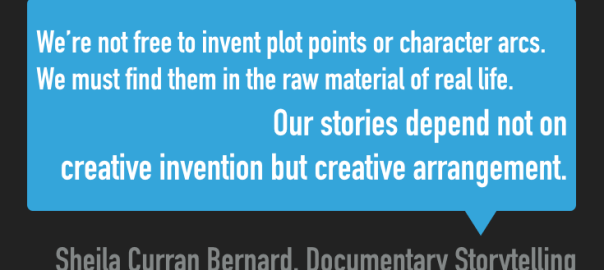
But in a crazy, noisy world, stories can help you find your voice – your personal voice and the voice of your business. Better still, stories come loaded with emotion, acting like glue, fixing information into our memories. Like Maya Angelou said, people forget what you say and do but they never forget how you made them feel.

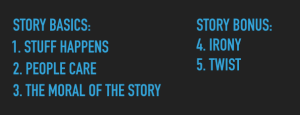
Here’s what stories need. Without these elements, you are just reading out facts and opinions (yawn).


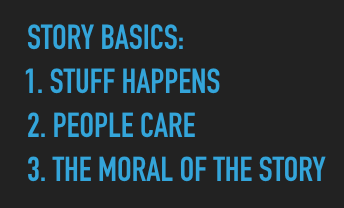
1. Stuff happens: We don’t tell stories about projects or companies or strategies or multi agency approaches. People tell stories about people doing stuff. This is the Who, What, Where and When of the action, with a beginning, middle and end.

So when you’re hunting stories, listen out for: “Last week…” “When I was in the Manchester branch…” “I met this woman called…” “And then…” “After all that…”

2. People care: if stuff happens AND it provokes an emotional reaction, then it’s probably a story. If it made people happy, sad, angry, proud, frustrated then they are much more likely to remember it than if it simply engaged their rational brain. This is the How of the story – how did it make you feel.

So listen out for: “I felt…” “I was so…”

3. The moral: for business stories, there has to be a moral to your story, otherwise it’s just chat. You’re not telling stories to entertain people, you want them to DO something different: buy your product, join your company, embrace new ways of working. A useful business story goes like this: stuff happened, it provoked this reaction and now we’re going to do this. So listen out for: “I realised…” “I learned…” “That’s why…”

Let’s try this out on a real story, and let’s add some bonus elements: Irony and Twist.


Back in the 70s, US journalist Ross Gelbspan was covering a conference on climate change and over-population. Looking for an angle on a dense academic subject, he realised that one of the speakers on the stage – Donella Meadows – was herself pregnant. What a wonderful irony, he thought, “she had found hope in the midst of all this doom and gloom.” This was the angle Gelbspan built his story on. Except that when the story came out, Meadows got in touch, saying “I’m not pregnant…” Decades later, Ross Gelbspan still cringes when he thinks of his mistake.

  • Stuff happens: journalist makes a mistake.
  • People care: he is mortifyingly embarrassed (so are we, just listening to it).
  • Moral of the story: never ever assume a woman is pregnant unless her waters are breaking right in front of you. Check your facts.
  • And the bonus ingredients:
  • Irony – the idea of someone campaigning against over-population adding to the world population by having a baby.
  • Twist – the sudden gasp when our understanding is turned upside down. She’s not pregnant! Oh no…!

If you want people to understand why fact-checking matters, tell them that story. Better still, go out and listen for the stories all round you, from your colleagues and customers. Become a story hunter and it will be your business secret weapon. 

Credit: Ross Gelbspan’s story is in Being Wrong, by Katheryn Schulz

More on using Irony as a creative tool here. More storytelling and presentation tools here.


Life lessons from a raindrop

I spent years trying to master 35mm photography, with mostly disappointing results. I never took a picture as beautiful as this one… so why is that?

This is NOT a story of improving technology. The camera on my Google phone is good, but the lens on my old Nikon FE was 100 times better. The life lesson from this raindrop is that technology allows me to improve my creative process – in two ways.

1. Creativity loves cheap failures. Here are all the attempts I made to photograph yesterday’s raindrop:

Most were rubbish. But it’s like Linus Pauling – double Nobel prize winner – told his students, if you want to have good ideas, you need to have lots of ideas and then throw the bad ones away.

Digital photography beats film because it makes failure so cheap. There’s nothing to stop you taking shot after shot until you get a good one. Then throw the bad ones away.

Digital = cheap failures.

My 35mm experiments were expensive – five or six quid to develop 36 shots, maybe only one of which would work. The cost of producing 90% disappointing shots hovered at the back of my mind every time I picked up the camera. Not so nowadays. I shoot as much and as varied as I like. The only cost is my time. Digital vs film is a perfect example of divergent thinking, which lies at the heart of every good creative process.

2. Expertise grows with rapid feedback. Psychologists Daniel Kahneman and Gary Klein reckon that expertise flourishes when we get “immediate and unambiguous feedback” on our actions. Think of the difference between learning to drive a car and learning to pilot a supertanker.

Every touch on the brakes or steering wheel gives the novice driver immediate and unambiguous feedback. We try, we learn, we improve. Steering a supertanker into a stormy harbour, with cross currents, winds and tides is much more subtle. 17 year olds learn to drive cars. I doubt there are many 17 year old supertanker pilots out there.

Digital photography is like learning to drive a car. We snap, we check, we snap again. Feedback is immediate and unambiguous, right there on our screen. The feedback on my 35mm film took days. By the time the photos came back from the lab, I’d forgotten what I was trying to learn.

So, Life Lessons from a Raindrop:

If you want to get good at anything, experiment as cheaply as you can, get clear feedback as quickly as you can.

And always look for beauty, even on the rainy days.

  • 11 tips on how to learn from your own mistakes here.

Credit: Supertanker picture from Pixabay.com

Storytelling & Pitching – Hyper Island training day

These two videos show how Nike changed their approach to storytelling. Their first TV ad from 1982 is about the company. The people who MAKE the shoe are the hero of the story. The second video from Nike’s 2012 ad campaign makes the people who WEAR the shoe the hero of the story.

Version 1 is your “foundation” story, the story of how you/your company got to where you are today. Version two is your “mentor” story – how you are helping your customers get where they want to go.

Remember, you can only really tell your foundation story once. You can tell as many mentor stories as you have customers.

Here’s the presentation deck from Hyper Island’s training day on storytelling & pitching. And here, with commentary, the first half of the training:

PDF worksheets available here.

See also this range of presentation tools to help you sell your best ideas.

Why don’t people listen when I talk about my work?

Probably because already they’re drowning in a sea of words.

There are so many words coming at us all the time that we’re desperate for a reason to dismiss yours and move on. But there will be things which are “front of mind” for your audience, and you can use these to hijack their attention long enough to get your message across. This short film will show you how to make your message Timely, Relatable, Unexpected and Emotionally Engaging.

Effective communication means more that just giving people a list of facts and hoping they remember them. Wrap those facts up in a story and you are far more likely to get people to pay attention. Better still, they will retell your story to others if you get it right.

These two videos show how Nike changed their approach to storytelling. Their first TV ad from 1982 is about the company. The people who MAKE the shoe are the hero of the story. The second video from Nike’s 2012 ad campaign makes the people who WEAR the shoe the hero of the story.

Version 1 is your “foundation” story, the story of how you/your company got to where you are today. Version two is your “mentor” story. This tells how you are helping your customers get where they want to go.

Remember, you can only really tell your foundation story once. You can tell as many mentor stories as you have customers. And let’s be honest, nobody likes listening to someone go on about how great they are. We find them boring.

Finally, a word on how to make a presentation work so that what you show doesn’t clash with what you tell. If you don’t get the visual and verbal parts of any presentation working in harmony, you’ll leave your audience bored or confused.

More storytelling advice here and presentation tips here

Click here to download the worksheets for this presentation